
-
Considered one of the worst kings of Spain, he came to the throne with the death of his father, Charles III, shortly before the outbreak of the French Revolution, which brought fear to all of Europe. He was a weak king, so he would not be able to rise to the occasion.
-
-
It end with the peace of Basilea, it was a treaty that ended the war between the French Republic and Spain and was signed in the Swiss city on July 22.
-
Conflict between the monarchy of Carlos IV of Spain and the First French Republic
-
Treaties signed by Spain, France, Prussia and Hesse-Kassel to end the French Revolutionary Wars.
http://batallashistoricas.com/c-guerras-napoleonicas/tratado-de-basilea/ -
It was carried out by Godoy and consisted of putting on the market, by means of a forced expropriation and public auction, the lands and goods that until then could not be sold and that were in the hands of the so-called "dead hands", the Catholic Church, and the so-called vacant lots and the communal lands of the municipalities, which served as a complement to the precarious economy of the peasants.
-
political and social economic system that ended when, on 19 March 1808, Ferdinand VII ascended the throne
-
Spanish territory dominated by the Napoleonic authorities during the Spanish War of Independence
https://youtu.be/vHuyHnr4y6I -
Political developments during the reign of Carlos IV that began when Fernando VII ascended to the throne and ended in the Cortes Generales and Extraordinary.
https://t1.up.ltmcdn.com/es/images/8/5/7/img_antiguo_regimen_resumen_1758_orig.jpg -
War conflict mainly between Spain and France which began with the uprising in Madrid against the French invasion of Spain and ended with the Treaty of Valençay which restored Ferdinand VII and left Spain free of foreign presence, although it did not prevent the invasion of French territory.
https://i.pinimg.com/originals/a6/24/52/a624525eacb1230452a403ae07e2e8f6.png -
-
The Cadiz Constitution, better known as 'the Pepa', recognised Spain as a monarchy, although it ended the absolute power of the king. To this end, the division of powers (legislative, executive and judicial) and national sovereignty was established, which meant that power no longer belonged only to the king, but to all Spaniards. The right to universal male suffrage was also established and Catholicism was made the official state religion.
-
In 1813, Napoleon agreed to recognise again Ferdinand VII of Bourbon as King of Spain, who had kept him imprisoned in France since his abdication in 1808. He therefore returned to Spain in 1814 after having spent five years in captivity in France https://1.bp.blogspot.com/-4Dfi0mNKj5k/T0bd9XV3VmI/AAAAAAAAA7Q/fL2ssthpolQ/s400/regeso%2Bde%2BFernando%2BVII.png
-
-
It was signed between Austria, Russia and Prussia on 26 September in Paris after the battle of Waterloo. https://3.bp.blogspot.com/-1RhkWGqVmnA/VWS_05pVH6I/AAAAAAAABno/DmIkeOPxm8c/s1600/Esquema%2B-%2BRestauraci%25C3%25B3n%2B1.jpg
-
In 1820 there was a liberal revolution in spain after a rather turbulent decade, it was the beginning of the 1820 Revolutions.
-
It was a radical movement that expressed the agitation of the working class, due to the changes resulting from the Industrial Revolution.
-
-
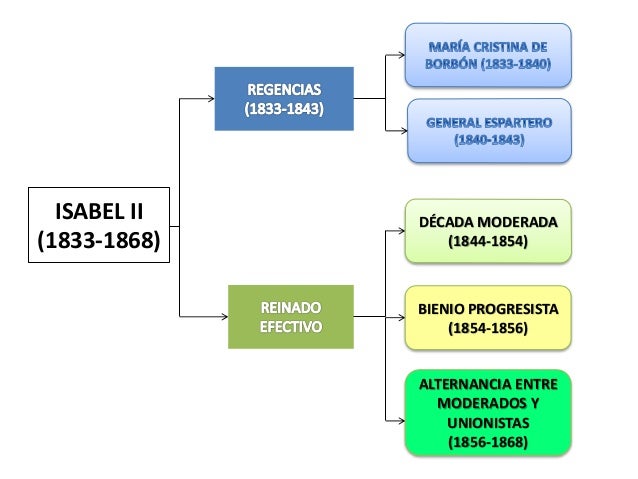
Isabel II of Spain, daughter of Fernando VII, is known as the Nymphomaniac Queen. Her father's premature death left the country in the hands of the king's wife
Many think that she is the queen who should never have come to the throne, since her education was poor and she came to the throne at the age of three -
in 1837 all forms of slavery were abolished
-
The First Carlist War was a civil war that took place in Spain between 1833 and 1840 between the Carlists, supporters of the Infante Carlos María Isidro de Borbón and an absolutist regime, and the Elizabethans or Christians, defenders of Isabel II and the Regent María Cristina de Borbón, whose government was originally moderate absolutist and ended up becoming liberal in order to obtain popular support. Translated with www.DeepL.com/Translator (free version)
-
Began with the construction of the first railway lines and has continued up to the present day, becoming one of the most important elements of Spanish society and economy.
-
Was the process of transformation of the agricultural and craft economy into an economy based on factories and the use of machines.
-
The growing discontent with Isabella II eventually led to the outbreak of the Spanish revolution in 1868
-
The period of Spain's contemporary history from the triumph of the revolution in September 1868 to the declaration of December 1874, which marked the beginning of the period known as the Bourbon Restoration, is known as the Democratic or Revolutionary Sexennial
-
The 1869 Constitution restored the right to universal male suffrage, following an era of censorship.
-
"The Knight King" , was King of Spain between 1871 and 1873.
His reign in Spain, lasting a little over two years, was marked by political instability. The six cabinets that followed one another during this period were unable to resolve the crisis, which was aggravated by the independence conflict in Cuba, which had begun in 1868, and a new Carlist war, which began in 1872 -


Plan projects on a visual timeline
Map milestones, phases, deadlines, and key events in one place so the sequence is easier to see and share. Timetoast is a timeline maker for work, school, research, and stories.